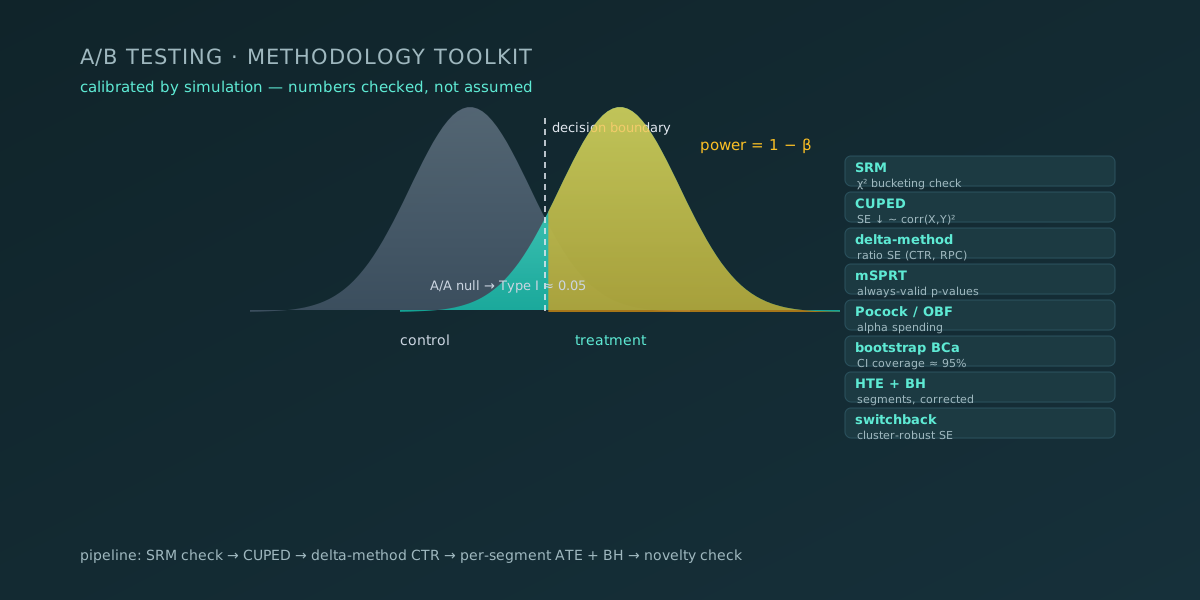
A/B Testing Methodology Toolkit
Business Context
An A/B testing method is only as good as its Type I error under the null and its power under a real effect. Rather than trusting asymptotic promises, each module simulates the pipeline end-to-end and reports the empirical rates.
Modules
| Module | Method | What the demo shows |
|---|---|---|
srm_test.py | Sample Ratio Mismatch (χ²) | catches bucketing/traffic bugs before any downstream test |
sample_size.py | Fixed-horizon sizing | n/arm for proportions and means |
delta_method_ratio.py | Ratio metrics (CTR, RPC) | correct SE for ΣY/ΣX; the naive per-unit t-test is biased |
cuped.py | Variance reduction | SE shrinks by ~corr(X,Y)² using pre-period data |
group_sequential.py | Alpha-spending boundaries | Pocock/OBF control Type I while naive peeking inflates it |
msprt_always_valid.py | Always-valid p-values | mSPRT lets you peek and stop any time, validly |
sequential_ratio.py | Sequential ratio metrics | delta-method + mSPRT for CTR under continuous monitoring |
sequential_ab_testing.py | Evan Miller’s sequential rule | reproduces the size table, validates Type I/power, sample savings |
bayesian_ab_test.py | Analytic Bayesian A/B | Beta-Binomial / Normal-Normal, P(B>A), expected loss, ROPE |
bootstrap_ci.py | Bootstrap CIs | percentile & BCa for skewed metrics |
heterogeneous_treatment_effects.py | HTE by segment | interaction model reveals Simpson-paradox-like cancellation |
multiple_comparisons.py | Multiple-testing correction | Bonferroni (FWER) vs Benjamini-Hochberg (FDR) |
novelty_primacy.py | Time-varying effects | treat×day interaction detects novelty decay / primacy growth |
switchback.py | Cluster & switchback designs | cluster-robust SE; naive over-/under-rejects; carryover bias |
test_simulator.py | Generic test calibration | plug any DGP + test → empirical Type I and power curve |
End-to-end pipeline
scripts/run_full_pipeline.py ties the modules into one realistic flow on synthetic data: SRM check → CUPED → delta-method CTR test → per-segment ATE with BH correction → novelty check → a markdown report in outputs/report.md.
Testing Philosophy
The tests/ suite re-runs every calibration with assertions:
- Type I error ≈ α (± tolerance) for each method under its null;
- CI coverage ≈ 95% for the bootstrap;
- naive peeking inflates Type I, always-valid / alpha-spending control it;
- the naive per-unit ratio SE is inaccurate, the delta-method SE is accurate;
- correctness on known-answer fixtures (SRM splits, segment uplifts, etc.).
Run
uv sync --all-groups
uv run pytest                 # calibration test suite
uv run python scripts/run_full_pipeline.py   # end-to-end demo → outputs/report.md
Impact
- 15 calibrated modules — from SRM to switchback, each with an A/A null check.
- Checked numbers — Type I ≈ α, coverage ≈ 95%, peeking controlled.
- Unbiased ratio metrics — delta method instead of the naive per-unit t-test.
- Cohesive pipeline — from SRM check to per-segment ATEs and a novelty check.